Building a home in Ghana from abroad should be a milestone, not a source of dread. Too often it goes the same way: years of hard-earned transfers, full trust placed in a relative back home, and then a holiday visit that reveals an empty foundation, a half-built shell or an unregistered plot.
The cause is rarely bad character. It is a system with no verification. Money moves, but nobody can check what it bought. Relying on closeness instead of records puts your savings at risk and strains the family relationships you meant to protect.
Grace Home Construction answers this with a structured process we call the Grace Ledger Framework. It is designed so you can follow every cedi and every stage of your build from London, New York or Toronto, without anyone in your family having to hold your money. This page is about that process. For the wider risks of buying land and choosing a contractor, read our diaspora guide to building in Ghana.
Where the money leaks
In informal builds, money usually leaks in three places.
- Inflated invoices. When a relative buys materials, suppliers learn the owner is overseas and prices drift above the market rate. On a multi-storey build that uses thousands of bags of cement, even a modest markup drains the budget before the first-floor slab is poured.
- Materials that never reach the site. Without a gatehouse logbook and a delivery check against the order, cement, iron rods and formwork props can be paid for and then sold on. You pay for a premium build and receive a weaker one.
- Cash paid to casual labour. When artisans are paid in loose cash, with no signed timesheets and no agreed output, progress can slow while the weekly payments keep coming.
Each leak starts with the same gap: nothing ties a payment to something you can see on site.
What a luxury villa costs in Accra in 2026
A luxury villa, for this article, means a four- or five-bedroom house of about 250 to 400 square metres of floor area, finished to a premium standard: good tiles, a proper kitchen, solid doors and aluminium windows, not a basic bungalow.
On this site the 2026 premium rate is about GHS 6,500 to GHS 8,500 per square metre. At that rate a villa of this size is roughly GHS 1.6 million to GHS 3.4 million for the structure and the finishes. Our separate size guide prices a standard four-bedroom storey, about 200 to 280 square metres, at GHS 900,000 to GHS 1,600,000. A luxury villa costs more because it is larger and the finish is higher. See the cost per square metre and the cost by house size.
That range excludes the land, the fence, a borehole, a bio-digester where the site is not on a public sewer, permit fees and the ECG deposit. A priced bill of quantities replaces the range once we have your drawings. Prices move with the cedi and with cement, so the bill is the figure you pay against, not the range in this article.
The Grace Ledger Framework: four safeguards
The framework keeps your build money out of personal hands and ties every payment to something that can be checked on site. Before you pay a mobilisation, ask us for one sample progress report. It is a short written note, dated photographs, and the stage those photographs belong to. If we cannot show you that, do not start.
- Traceable payments only. A client abroad does not send cash to a relative, and we do not ask them to. You pay Grace Home Construction by bank transfer, including an international transfer, into the company account. Each transfer is against the signed bill of quantities and the stage schedule, and each one is receipted. The money does not pass through a family member, so a relative cannot redirect it. Clients in Ghana may still pay by the method agreed in the contract. The rule for a build directed from abroad is the company account and a receipt.
- Payment by stage, after the work is checked. A mobilisation payment starts the work. Every later payment follows a stage that has been inspected. If a stage does not pass, the next payment is not due.
- Remote visibility. You do not need to fly to Accra or send a relative to check on us. We send a written progress report with dated site photographs and the stage that has been completed, so you can compare what you have paid with what is standing, from your phone or your laptop.
- Professional sign-off. Every drawing set is prepared for review and stamping by a registered architect and a registered structural engineer (GhIE) before it goes to the Assembly. Setbacks are taken from your site survey. We do not guess them. A sound structural design, on the real plot, makes a stop-work or demolition notice far less likely. Licensed professionals answer for their own design and certification. You keep your own obligations as owner, so we give you the stamped drawings and the approvals to hold.
What the work looks like before the next payment
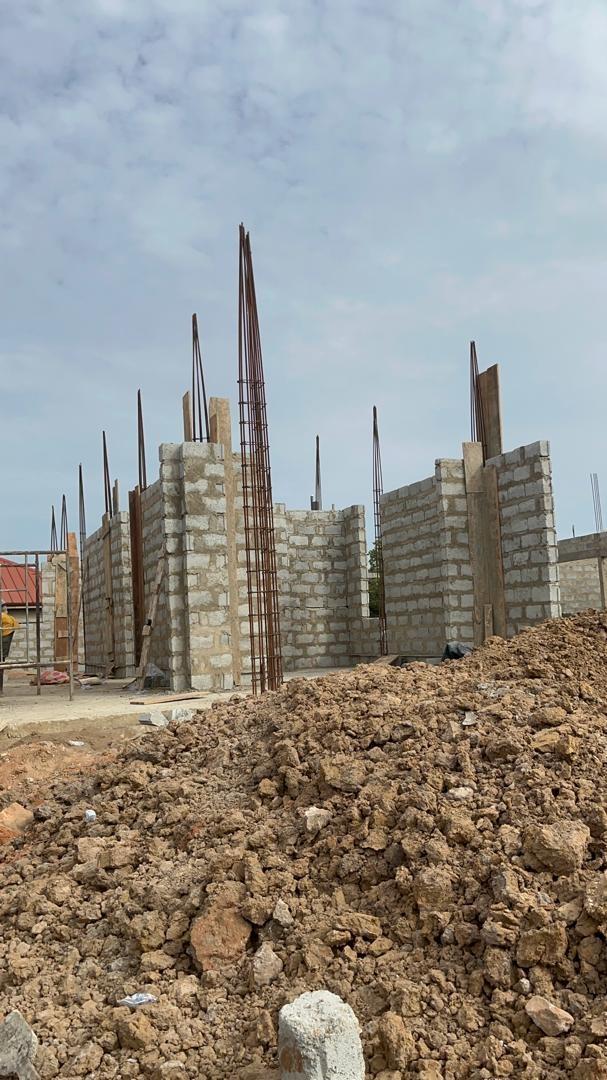
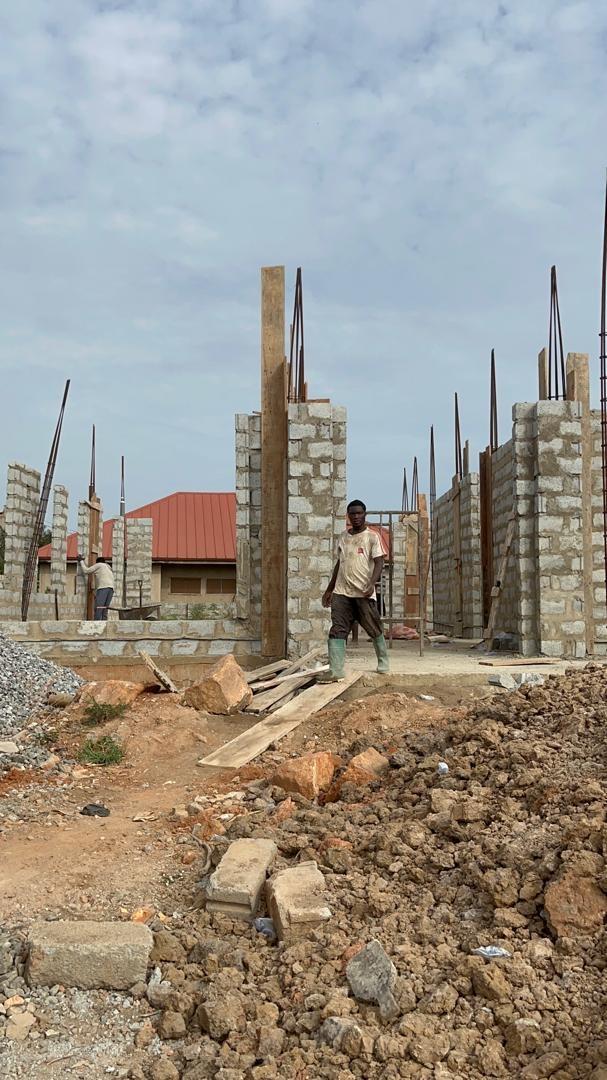
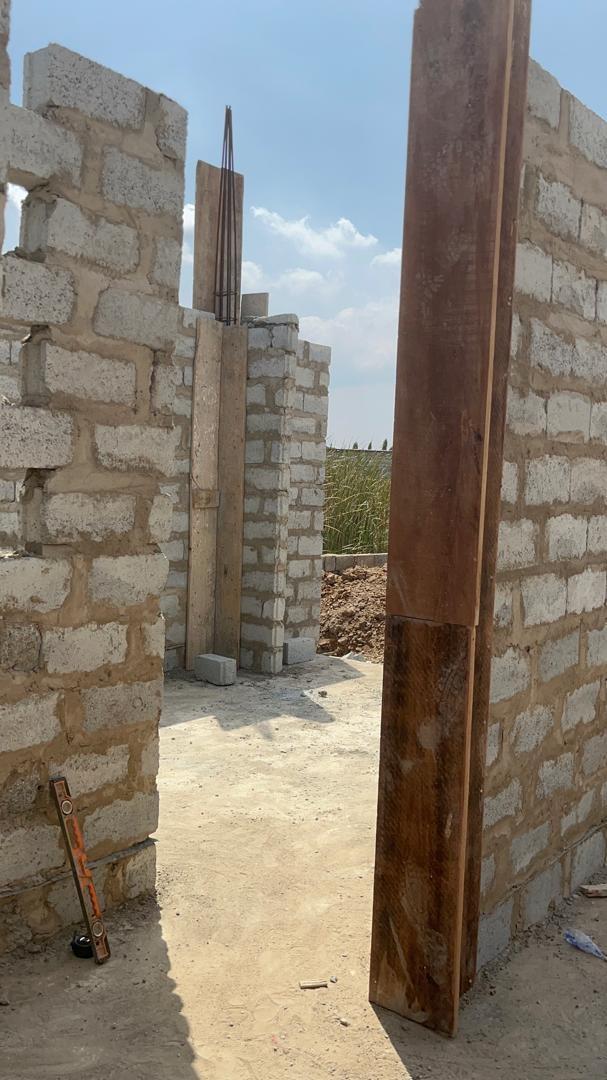
These photographs are from a Grace Home Construction site at ground-floor stage. The sandcrete columns and walls are up, and the starter bars are left standing for the next lift. A client abroad receives dated photographs like these, with the stage they belong to, before the next payment is due.
How the stages are paid
The stages below are the ones we use on a two-storey villa. A larger house adds a stage for each extra floor. The cedis for each stage come from your bill of quantities, not from a fixed percentage in this article.
| Stage | What is built | When it is paid |
|---|---|---|
| 1. Mobilisation | Hoarding, site store, setting out and welfare. | The agreed mobilisation, before the footing is dug. |
| 2. Substructure | Excavation to firm laterite, blinding, the footing and the ground slab. | After the foundation level is checked on site. |
| 3. Ground floor | Columns, sandcrete blockwork and lintels up to the first-floor slab. | After the columns reach the agreed level, for example +3.000 m. |
| 4. Upper floor | The suspended slab, the staircase and the upper walls. | After that storey is standing and the slab has been cast. |
| 5. Roof | The roof made watertight, whether a concrete parapet roof or the roof that was drawn. Rainwater is taken to the compound drain, not into a digester. | After the roof holds water. |
| 6. Windows, doors and services | Windows and doors as specified, wiring, plumbing, and a bio-digester and soakaway where there is no public sewer. | After they are fixed and tested. |
| 7. Finishes | Plaster, tiles, ceilings, paint, kitchen and bathrooms. | After the rooms are ready to walk through. |
| 8. Handover | Cleaning, keys, the stamped drawings, the receipts and the photograph record of each stage. | After a joint inspection, including by video if you are abroad. |
Build with clarity
Well-located land in Accra can gain value over time, and a well-built villa can hold that value. The asset is only as safe as the process that builds it.
Replace trust in a relationship with records you can check: a priced bill of quantities, payment by stage, dated photographs and professional sign-off. Your family can then stay what it should be, family, and your capital goes into the building.
Talk to us
If you have a plan or a plot in Accra and want to build without sending money through personal networks, contact Grace Home Construction.
- Email: info@graceconstructiongh.com
- Phone: +233 (0) 54 410 3068 / +233 (0) 59 739 4674
Grace Home Construction. Built to last, designed for modern living.